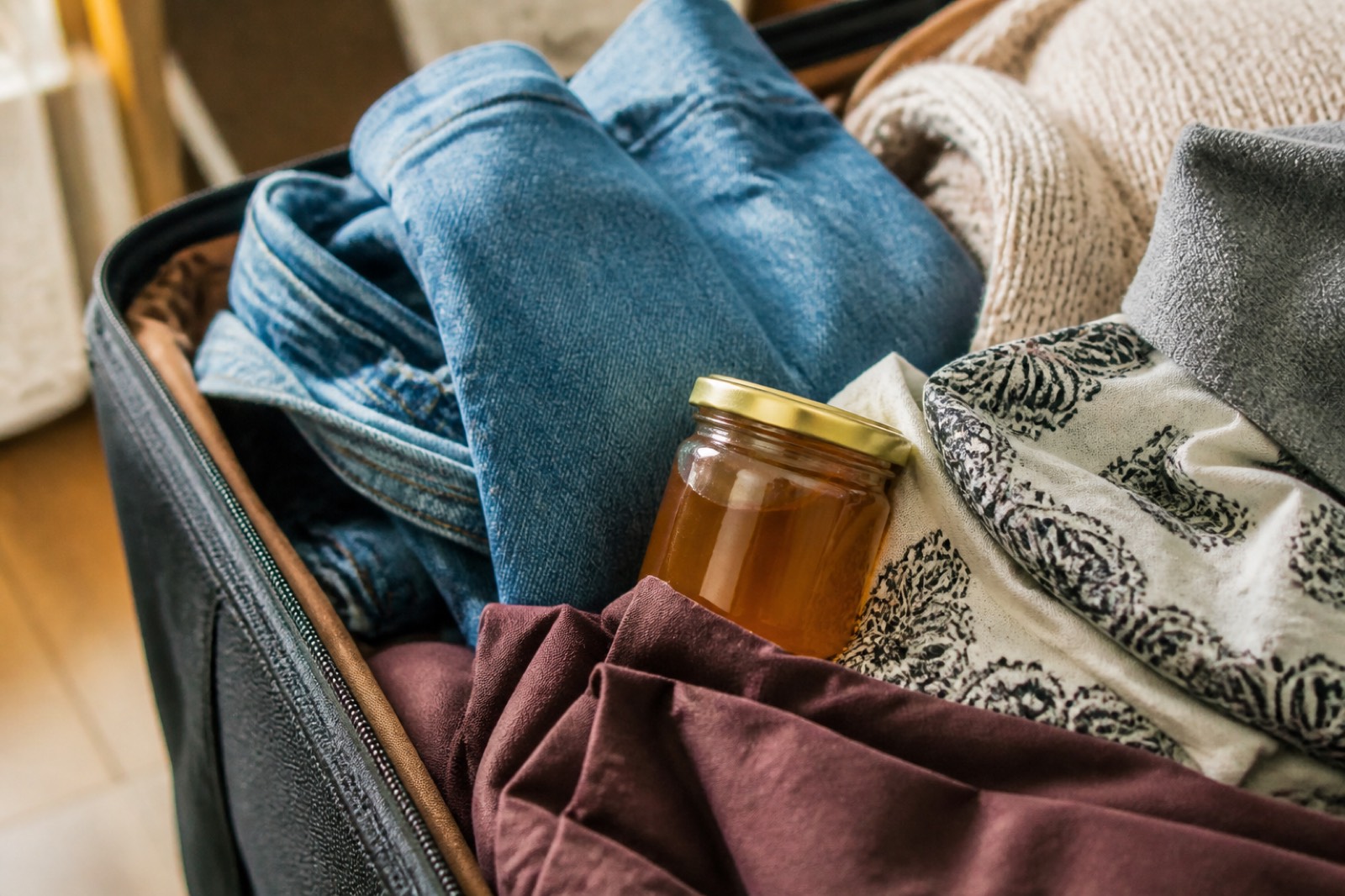
A jar of honey looks like an easy gift: small, sealed, nothing to cook. Then you search whether you can take it to China and find three different answers. Some are about airport security. Some are about customs. Others are simply “I took one last year.”
Those answers aren't interchangeable. Here's what to check before the jar goes in your suitcase.
Can you bring honey into China?
The national prohibited carry-in list we reviewed does not name ordinary honey as a standalone prohibited item. That is not blanket permission to bring any honey product into mainland China. Check your exact product with Chinese Customs before traveling, and declare it for inspection on arrival.
We could not verify a universal “one jar” or “2 kg” honey allowance for travelers. Treat claims like that cautiously unless they link to a current rule that actually covers your situation.
| Your question | What to do |
|---|---|
| Is my particular honey allowed? | Confirm the product, origin and quantity with Chinese Customs. |
| Can it go in checked luggage? | Check the airline's baggage rules; checked bags still go through customs. |
| Can it go in hand luggage? | Check liquid limits at departure and any transfer security checkpoint. |
| Does “sealed” or “a gift” settle it? | No. Keep the label, but don't treat the packaging as permission. |
This guide covers mainland China. If you enter Hong Kong or Macao along the way, check their rules too.
What the Chinese customs list actually says
The official prohibited list specifically names categories such as meat, dairy and eggs. It does not explicitly list ordinary honey. It also includes other prohibited quarantine items and says other applicable rules still apply. That is why “all bee products are banned” is too broad, and “honey isn't named, so anything goes” goes too far the other way.
A traveler's report that a jar went through is useful context, but it doesn't establish the rule for your jar. The same goes for a shop saying it sells to customers flying to China.
For the rest of your suitcase, use the food entry guide. Honey needs its own checks; a rule about cheese isn't a reliable shortcut.
Plain honey, Manuka, honeycomb: describe the actual product
The word “honey” can cover quite different things. This table tells you what to include in an inquiry, not which products have automatic permission.
| What you're packing | What Customs needs to know |
|---|---|
| Plain supermarket honey | Country of origin, ingredients, processing information and total quantity. Photograph the original label. |
| Manuka honey | The same details. A grading label describes the product; it is not a customs approval. |
| Raw or farm-shop honey | Say that it is raw or unprocessed, if that is how it is sold. Ask the producer for details if the label is sparse. |
| Honeycomb or honey containing comb | Mention the comb explicitly. Don't describe it only as bottled honey. |
| Honey mixed with royal jelly, propolis or pollen | Supply the full ingredients and product form. An answer about plain honey may not cover the mixture. |
| Honey sweets or lozenges | Send the candy's full ingredients. A honey flavor on the front doesn't tell you what else is inside. |
If it is an expensive gift, get an answer before buying it. That saves a much more awkward decision at the airport.
Honey in checked luggage vs hand luggage
Checked bags
Putting honey in checked luggage can avoid a cabin liquid limit. It does not change China's entry or declaration rules.
Once you've confirmed the product can travel, keep it in its labeled container, seal it inside a leakproof bag and cushion the jar. Keep a photo of the label on your phone so you can show it without unpacking everything. These are packing suggestions, not exemptions.
Hand luggage
Honey can count as a liquid or gel at security even when it is thick. For example, US TSA guidance limits honey in carry-on bags to 3.4 oz / 100 ml and permits it in checked bags. That describes US security screening, not permission to import it into China.
Use your departure airport's current rules, including its liquids-bag requirements. Check transfers too, particularly if you will pass through security again.
Watch the units: 250 g on a honey label is a weight, not the container's capacity in ml. Don't use the weight printed on the jar to decide whether it meets a cabin volume limit.
How much honey can you bring as a gift?
We haven't verified a honey-specific allowance that lets every traveler bring a set number of jars or kilograms. “For personal use” and “for a friend” are useful facts to explain, but neither answers the quarantine question by itself.
When asking Customs, give the number of jars and the net weight of each one. “Two sealed jars, 250 g each” is much easier to assess than “a little honey.” Tell them whether you are carrying gifts, personal food or goods for sale.
What to ask Customs before you fly
The official passenger quarantine service page lists local customs offices and the 12360 customs hotline as consultation channels. If you're outside China, look up the published contact details for the customs office at your arrival port; don't assume a domestic short number will connect from abroad.
Have these ready:
- Photos of the front label and ingredients.
- Country of production, product name and processing details, if shown.
- Number of containers and total net weight.
- Arrival airport, travel date and whether it is a personal gift.
You can adapt this message:
I will arrive at [airport] on [date]. I would like to carry [number] sealed jars of [product], made in [country], weighing [weight] each, as personal gifts. The ingredients are [ingredients]. May I bring this product in my passenger baggage? Are any documents or quarantine procedures required? I can provide photos of the label.
Keep the reply with your travel notes. It helps you follow the advice given; it doesn't replace inspection on arrival. If you cannot confirm an expensive jar in time, buying a gift after arrival is the simpler option.
Declaring honey on arrival
China's baggage declaration announcement requires animal and plant products and other quarantine items to be declared. Use the red channel to show the honey and its label to Customs, and complete the required declaration. A seal or gift bag doesn't remove that step.
Declaring an item is not the same as getting permission to keep it. Follow the officer's instructions rather than assuming a declaration will override a restriction.
These phrases help identify the product and ask what to do:
| English | Chinese | Pinyin |
|---|---|---|
| I have honey to declare. | 我带了蜂蜜,需要申报。 | Wǒ dài le fēngmì, xūyào shēnbào. |
| Here is the ingredient list. | 这是配料表。 | Zhè shì pèiliào biǎo. |
| It is a gift for a friend. | 这是送给朋友的礼物。 | Zhè shì sòng gěi péngyou de lǐwù. |
| Can this product enter China? | 这个产品可以带入中国吗? | Zhège chǎnpǐn kěyǐ dàirù Zhōngguó ma? |
Before you close the suitcase
Confirm the jar first, then decide which bag it goes in. If you're also packing sweets, check the chocolate guide separately rather than treating every sealed food the same way.
Found a newer official answer or something unclear here? Send us feedback, ideally with the source link. Product clearance questions should go to Customs.
Sources checked October 21, 2026: national prohibited carry-in and postal list, passenger quarantine consultation channels, baggage declaration announcement effective April 1, 2025, and TSA food screening guidance.