I had a half-open bag of trail mix in my carry-on when I landed in Shanghai — almonds, chocolate, and a few beef-jerky sticks a friend packed "just in case." Customs didn't make a scene, but the officer pulled the jerky, pointed at the disposal bin, and moved on. The chocolate stayed. That five-second moment taught me more than any forum thread: China Customs food rules are not the same as your airline's snack policy, and "it's sealed" does not automatically mean "it's fine."
If you are packing for China and wondering whether your home-country snacks, protein bars, or allergy backups can come along, this guide is for you. Rules can change, and individual officers have discretion at the border — but the official framework is clearer than most travelers expect once you separate quarantine bans from personal-use allowances.
The Short Answer
You can usually bring small amounts of commercially packaged, shelf-stable snacks for personal use — think biscuits, candy, instant noodles without meat, sealed tea, or plant-based protein bars with no animal ingredients.
You generally cannot bring fresh fruit, vegetables, raw or cooked meat, most dairy, eggs, homemade food with animal products, or items on China's official prohibited quarantine list — regardless of how well they are wrapped.
If you are unsure about an item, do not rely on "nobody checked last time." Use the disposal bins before the inspection lane, choose the correct customs channel, or declare when required. Under China's updated luggage rules (GACC Order No. 276, effective April 1, 2025), travelers must declare truthfully when carrying items that require declaration — including many plant and animal products.
China Customs vs. Your Airline — Two Different Rulebooks
This trips people up constantly.
| Airline baggage rules | China Customs / quarantine rules | |
|---|---|---|
| Who sets them | Your airline and departure/arrival aviation authorities | General Administration of Customs (GACC), MARA, health/quarantine agencies |
| What they control | Liquids over 100 ml in cabin bags, weight limits, lithium batteries, some dry-ice or gel packs | Prohibited plants, animals, and products; declaration; duties on excess personal items |
| Typical food issue | "Is this liquid?" or "Does this exceed weight?" | "Does this contain meat, fresh produce, or eggs?" |
| Getting past the airline | Does not mean China will allow it |
Example: a 200 ml jar of honey may fail the cabin liquid limit even if customs would otherwise treat it as a packaged product. A vacuum-sealed salami may be dry enough for your airline but is still prohibited animal product at the Chinese border.
Pack for both rulebooks, not whichever is easier.
What Usually Happens at the Border
China's main international airports use red channel (declare) and green channel (nothing to declare) systems. Under GACC Order No. 276, you must use the red channel if you carry prohibited items, restricted items above limits, plants or plant/animal products subject to quarantine, or other goods that legally require written declaration.
In practice, officers may:
- Wave you through if your bag looks like normal personal luggage
- Ask to open a bag if they see fruit, meat, or undeclared agricultural products
- Confiscate prohibited items without much discussion
- Ask you to dispose of items in quarantine bins — using those bins before inspection is allowed and is not treated as a penalty
The official Prohibited Carrying and Mailing List (Ministry of Agriculture and Rural Affairs & GACC Announcement No. 470, published October 20, 2021) applies to inbound travelers' carry-on and checked luggage. MARA and GACC have stated the list may be adjusted based on risk assessments — another reason not to treat blog posts from 2019 as current law.
Common Food Categories: What Travelers Should Know
This table reflects the 470 Announcement list and common customs practice. When in doubt, check customs.gov.cn before you travel or dispose of the item.
| Food category | Typical carry-in status | What travelers should know |
|---|---|---|
| Fresh fruit & vegetables | Prohibited | Apples, oranges, salad kits, chili peppers, tomatoes — all high-risk for quarantine. Even one piece can be confiscated. |
| Raw or cooked meat | Prohibited | Includes jerky, sausages, ham sandwiches, canned meat with animal content, and broth cubes with meat. |
| Meat-based snacks & instant foods | Usually prohibited | Beef jerky, pork floss, chicken-flavored crisps with real meat ingredients — packaging does not override the list. |
| Dairy & eggs | Prohibited (most forms) | Fresh milk, cheese, butter, yogurt, fresh eggs, and many egg-based sauces. Rules are strict on animal-origin dairy. |
| Seafood & aquatic products | Prohibited (most forms) | Fresh, frozen, or many processed seafood items. Some dried or heavily processed sauce-type products have narrow exceptions — do not assume yours qualifies. |
| Homemade food | High risk | Baked goods with butter or eggs, family vacuum-sealed meals, or jars of home preserves often contain prohibited categories even if "just for personal use." |
| Packaged snacks (no meat/dairy/egg) | Often allowed in small amounts | Biscuits, plain chips, candy, chocolate, sealed tea, instant noodles without meat or egg ingredients — for reasonable personal use. |
| Protein bars & supplements | Case-by-case | Plant-based bars often pass; bars with whey, egg white, or collagen may not. Powdered supplements — check for animal-derived ingredients and quantity. |
| Baby formula & baby food | Case-by-case | Commercially sealed products for infant use are often carried by parents; large quantities may trigger questions about personal-use limits or declaration. |
| Spices & dried plant products | Case-by-case | Whole seeds with germination potential, fresh herbs, and plant materials with reproduction ability face stricter control. Commercial dried spice jars are usually lower risk than fresh plant material. |
| Honey & jams | Case-by-case | Processed and sealed jars may be treated as packaged food, but fruit content, liquid limits (carry-on), and quantity still matter. |
"Reasonable personal use" is a core concept in GACC Order No. 276: luggage should be for self-use, not commercial import. A suitcase full of identical supplement bottles looks like cargo, not a travel snack.
Bringing Food for Dietary Restrictions
Travelers with allergies, vegetarian, vegan, halal, or other dietary needs often want backup food from home. That is understandable — but China’s quarantine rules care about product type, not your reason for carrying it.
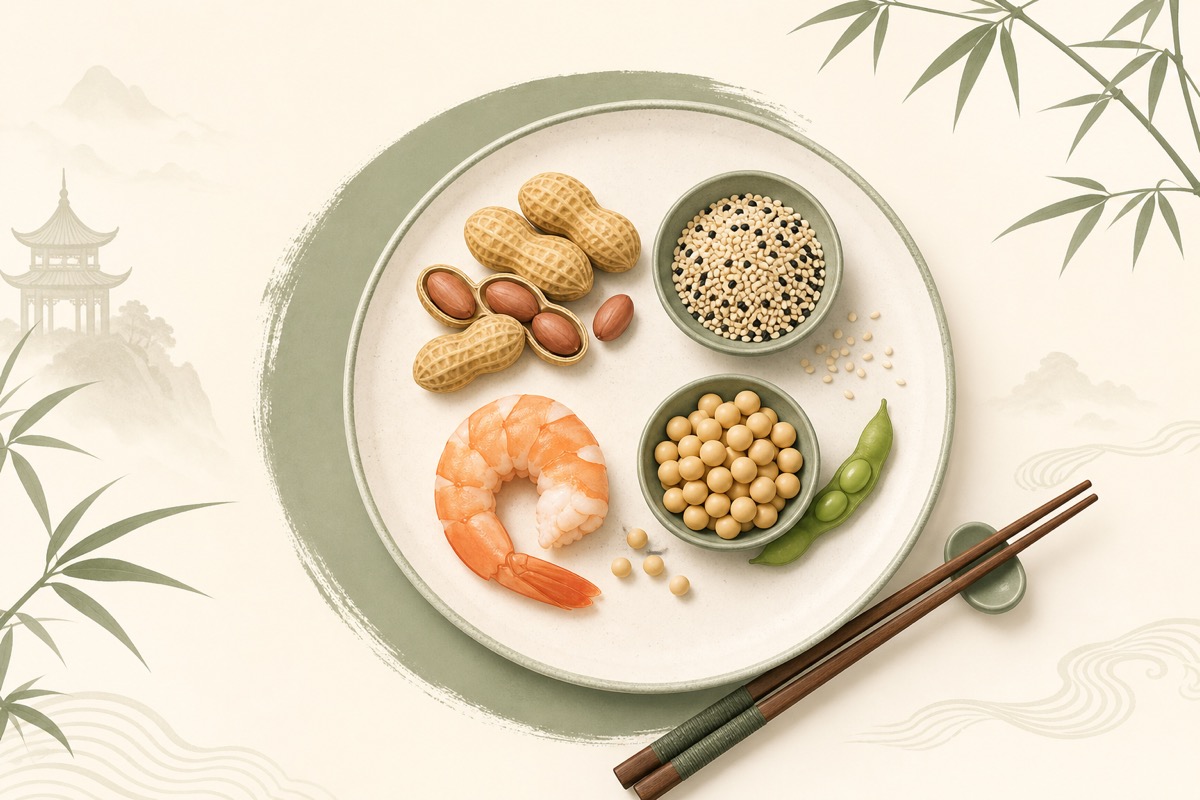
Allergies (peanut, tree nut, dairy, egg, seafood, gluten)
- Often workable: Sealed, shelf-stable snacks with clear ingredient labels and no prohibited animal or fresh plant content — plain rice crackers, certain dark chocolate bars, specific brands of oat milk powder (check for dairy traces and quantity).
- Usually not workable: Homemade allergy-safe cookies (egg/butter), fresh fruit for a plane snack, or meat-free jerky if it is still meat product under the list.
- Better strategy in China: Carry ingredient cards in Chinese, learn a few dining phrases, and use apps or guides to find safe local options — backup snacks help most on arrival day, not for the whole trip.
Vegetarian and vegan
- Plant-based packaged snacks (nuts, dried fruit commercially packaged and not fresh, vegan bars without honey/egg/dairy) are commonly carried in small amounts.
- Fresh produce is still prohibited even if you are vegan.
- Do not pack nutritional yeast or mushroom spore products assuming they are "just food" — biological materials can fall under other restricted categories.
Halal and no-pork travelers
- Halal-certified packaged snacks without meat may be fine in small quantities; any meat product — including halal beef jerky — falls under prohibited animal products on the official list.
- China has extensive halal dining options in many cities; packing a few non-meat, sealed snacks for transit is reasonable; packing meat "because halal" is not an exemption.
Medical or specialty diet foods
- Prescription medical foods and specific clinical products may have separate rules and documentation requirements — contact the Chinese embassy/consulate or customs information line for your situation if you depend on a medical product.
- General "diet" products without approval paperwork are treated like ordinary food.
Useful Chinese Phrases
Show your phone screen if an officer asks about food. These are for border context, not restaurant ordering.
| English | 中文 | Pinyin |
|---|---|---|
| This is for personal use only | 这是个人自用 | Zhè shì gèrén zìyòng |
| Commercially packaged snack, no meat | 商业包装零食,无肉类 | Shāngyè bāozhuāng língshí, wú ròulèi |
| I can dispose of this item | 我可以丢弃这个物品 | Wǒ kěyǐ diūqì zhège wùpǐn |
| Where is the quarantine disposal bin? | 检疫丢弃箱在哪里? | Jiǎnyì diūqì xiāng zài nǎlǐ? |
| Do I need to declare this? | 这个需要申报吗? | Zhège xūyào shēnbào ma? |
Safer Options — What I'd Pack Instead
If I were flying in tomorrow with dietary restrictions, I'd pack:
- A small clear bag of sealed, plant-based snacks — rice crackers, dark chocolate, instant noodle cups labeled vegetarian, tea bags
- Printed Chinese allergy or diet cards — more useful than 20 protein bars
- Photos of safe product labels from home brands I trust — for reference, not for customs proof
- Nothing fresh — eat the apple before landing, not after
- A plan for day one — convenience-store options in major Chinese cities are better than most travelers expect; halal noodles, soy milk, and plain rice dishes are easy to find
What I would not pack: jerky, cheese, fresh fruit, homemade cookies, or a month's supply of supplements in identical bottles.
What to Do If You Are Unsure
- Check the official list — MARA & GACC Announcement No. 470 (prohibited carry-in quarantine items) and GACC Order No. 276 on gov.cn / customs.gov.cn
- Read the ingredient label — meat, egg, dairy, or fresh plant content is the usual trigger
- Use airport quarantine disposal bins before inspection if you realize mid-flight you packed something risky — this is the lowest-stress fix
- Choose the red channel and declare if you are carrying items that require declaration — failing to declare when required can create bigger problems than losing a snack
- Do not argue at the counter — if an item is confiscated, you are usually better off complying and replacing it locally
Regulations can change. This guide is practical information for travelers, not legal advice. For high-value, medical, or commercial shipments, consult official customs channels before you fly.
After You Land
Packing is the short problem. The first restaurant is the long one — especially with a peanut allergy or a no-pork rule.
- Peanuts: What to eat in China with a peanut allergy
- No pork: First meal in China when you don't eat pork
- Wider maps: common allergens and hidden pork
Still unsure about a snack in the bag? Use the food checker before you fly.
Final Tip
Before you zip your bag shut, pull out everything edible and sort it into two piles: "fresh / meat / dairy / egg" and "sealed shelf-stable plant-based." Put the first pile back in your kitchen. That one habit saves more grief at Shanghai or Beijing immigration than any clever packing hack.
Clearing the border is one evening. Eating for the next two weeks is the actual trip. Pack light, then decide the first meal on purpose — not at the first picture-menu shop off the metro.